

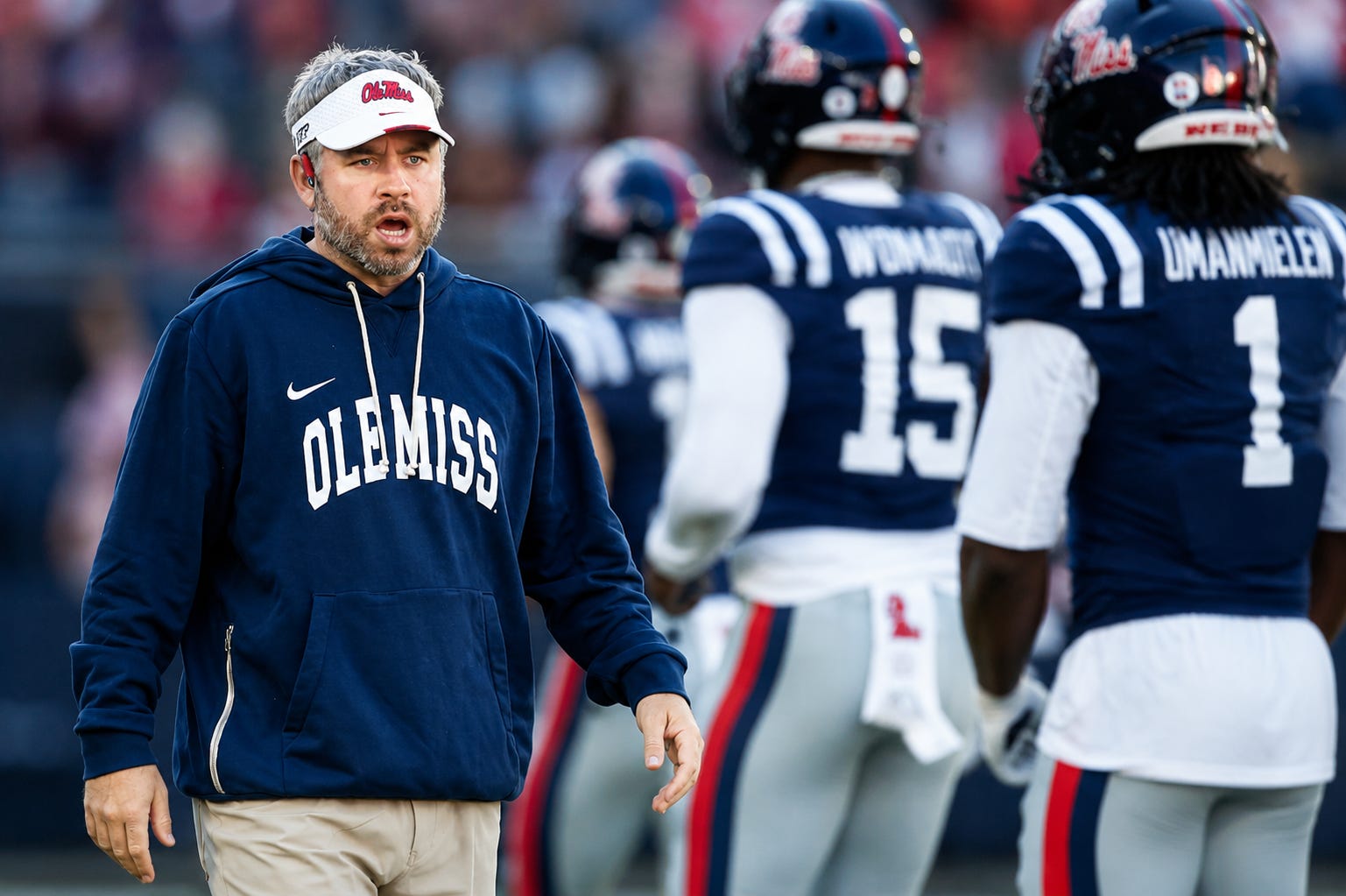
Pete Golding’s first major test as a head coach came with almost no runway. He was promoted on Nov. 30 with Ole Miss already headed to its first College Football Playoff, and less than three weeks later the Rebels beat Tulane 41-10. Then they erased a nine-point halftime deficit to beat Georgia 39-34 in the Sugar Bowl before their run ended 31-27 against Miami in the national semifinal.
It was an impressive first audition. It was not, however, a clean preview of what a Pete Golding program would look like. Much of Lane Kiffin’s offensive structure remained in place for the playoff, including offensive coordinator Charlie Weis Jr., who was already headed to LSU but returned to call plays. Golding’s job was to keep a championship contender moving without allowing the coaching upheaval to derail it.
His message fit the moment. “I think this group is focused on the mission, not the man,” Golding said before the playoff opener. Before the semifinal, he went a step further: “I’m replaceable, you’re replaceable, our players are replaceable.” His point was that a healthy program should be bigger than any one person.
That makes 2026 the more revealing test.
Can Golding sustain what Kiffin built?
The offensive staff took the biggest hit. LSU hired away the coaches responsible for Ole Miss’ offensive coordinator, running backs, tight ends/co-offensive coordinator, wide receivers/pass game, inside receivers and quarterback support roles. Defensively, Ole Miss lost its linebackers coach and a pass-rush assistant, but most of the defensive infrastructure remained. The Rebels also retained their offensive line/run-game coordinator and quarterbacks coach.
Golding’s answer on offense was not to start over. He brought John David Baker back to Oxford. Baker spent 2021-23 at Ole Miss, including two seasons as co-offensive coordinator, before leaving to run East Carolina’s offense. In 2025, ECU ranked 15th nationally in total offense at 460.4 yards per game. Baker returns with familiarity with the system and proof he could successfully run his own offense elsewhere.
Golding’s path to this point was much more gradual. He began as a graduate assistant at Delta State in 2006, then worked through Tusculum, Delta State, Southeastern Louisiana, Southern Miss and UTSA before Nick Saban brought him to Alabama. Golding spent five seasons coordinating the Crimson Tide defense from 2018-22, a run that included three SEC championships and the 2020 national title.
He arrived at Ole Miss as defensive coordinator in 2023. By 2024, his defense led the nation with 52 sacks and 120 tackles for loss, both school records.
The football résumé explains why Ole Miss trusted him. The more interesting part is what he is changing now that the entire program belongs to him.
“We don’t sugarcoat things,” Golding said during spring practice. “We tell players exactly how it’s going to be.”
Running back Kewan Lacy described him similarly at SEC Media Days, saying Golding is the same person every day regardless of who is standing in front of him. “It’s easy to play for a coach like that who is going to keep it real with you.”
The most tangible change may be the offseason itself. Golding hired a new strength staff, shifted toward velocity-based training and divided the offseason into more defined developmental phases. When defensive tackle Will Echoles was asked how it compared with the previous setup, he called the structure “very different” and said it was “better on our bodies, as far as the recovery part.”
That matters with the amount of new personnel Ole Miss is trying to integrate. Golding said the offseason roster included 51 newcomers, with 29 coming through the transfer portal. Spring became less about racing through installation and more about teaching the roster, evaluating roles and establishing how the program would operate.
By late April, Ole Miss was running a full mock game week months before playing an actual game. Golding pointed to linebacker, the defensive front and receiver as three of the groups that had made the most progress during spring. Syracuse transfer Johntay Cook said the chemistry in the remodeled receiver room came almost immediately.
“It was kind of like love at first sight, if that makes sense,” Cook said. “We all just gelled so easy.”
There are encouraging signs in August, too. Ole Miss entered fall camp with 49 returning lettermen but must replace 13 starters from last season. Golding has continued emphasizing game-like situations as the Rebels prepare for Louisville, while the program’s transfer class finished No. 2 nationally in 247Sports’ rankings.
What does not appear to have changed is the expectation.
Defensive coordinator Bryan Brown put it plainly during the spring: “It’s not the ‘We hope we can win’ mindset. It’s the ‘We’re going to win every single football game.’”
And that may be the most difficult part of what Golding inherited.
Ole Miss is no longer trying to become relevant. It has won at least 10 games in three consecutive seasons, just finished 13-2 and came within four points of playing for a national championship. There is no rebuilding grace period attached to this transition.
Other programs have shown that promoting from within can preserve momentum, but rarely without some turbulence. Notre Dame faced a similar question when defensive coordinator Marcus Freeman replaced Brian Kelly after Kelly left for LSU in 2021. The Irish went from 11 wins to 9 in Freeman’s first full season before eventually reaching the national championship game in his third.
Continuity can protect a program. It cannot guarantee the transition will be seamless.
Louisville gets the first regular-season look at Golding’s version of Ole Miss on Sept. 6 in Nashville. The Cardinals are not catching a rebuild. They are catching a team that retained much of its core, added one of the nation’s top transfer classes and deliberately preserved much of the offensive DNA that made Ole Miss dangerous under Kiffin.
What nobody knows yet is whether last winter’s playoff run proved Ole Miss had already become bigger than Kiffin, or whether it was one final surge of the program he built.
For the first time, the answer belongs entirely to Golding.
Give me Brohm all day ;)