

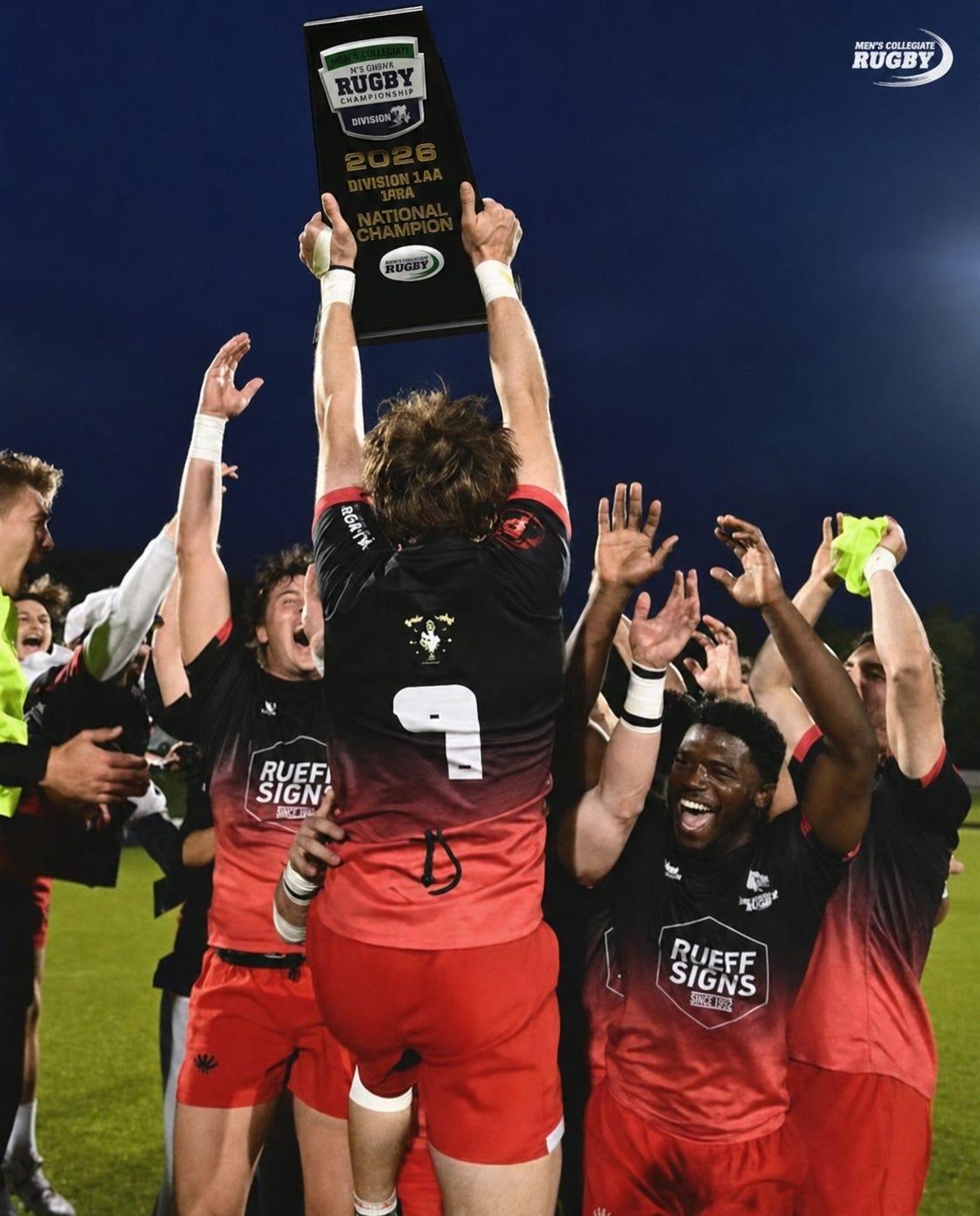
Louisville has played for four national championships since 2022. It has won two of them.
And there is a pretty good chance most Louisville fans couldn’t name a player on the team.
That can start changing this fall.
Louisville Rugby opens its 2026 fall season Friday, Sept. 4, against Tennessee in Nashville, beginning another run through a corner of college sports that operates largely outside the spotlight.
College rugby exists outside the NCAA structure most of us understand. But tucked inside UofL’s club sports program is something worth knowing about: a legitimate national championship rugby program.
Where exactly does Louisville play?
Louisville competes in Division I-AA of National Collegiate Rugby, commonly called NCR.
Forget what I-AA means in football. This is a completely different system. NCR is one of the major governing organizations for collegiate rugby in the United States and includes more than 680 men’s and women’s clubs across its membership.
On the men’s side, Premier sits at the top of the structure, followed by Division I-AA, Division II and Division III. Louisville competes at the D1-AA level in the Mid-American Rugby Conference, or MAC.
The 2025 conference included seven programs: Louisville, Bowling Green, Cincinnati, Dayton, Ohio, Pitt and Western Michigan.
So Louisville isn’t claiming to be the best rugby team at every collegiate level in America. What the Cardinals have become is one of the nation’s strongest programs at the D1-AA level.
That’s an important distinction but still quite impressive.
And yes, they’ve really been winning championships
This isn’t the result of one great weekend.
Louisville reached the national championship match in traditional 15-player rugby in 2022. Then it did it again in 2023, finishing as national runner-up both times.
In the spring of 2024, Louisville broke through in rugby sevens. The Cardinals went 4-0 at the Collegiate Rugby Championship, outscoring their opponents 114-5 on the way to a national championship.
They returned to the national semifinals in 2025 before making another run in 2026. Louisville entered the Division I-AA national sevens championship as a No. 1 seed and worked its way through the bracket before beating South Carolina 26-12 for the title.
That’s two national championships in three springs and four national championship appearances across 15s and sevens since 2022.
At some point, it stops being a nice run. It becomes the standard.
Fifteens and sevens: one program, two versions of rugby
The Cardinals compete in both 15s and sevens.
Fifteens is the traditional version of rugby union, with 15 players per side and 80-minute matches. Louisville’s primary 15s competition takes place in the fall.
Then the game opens up in the spring.
Sevens uses just seven players per side on essentially the same-sized field, with much shorter matches. That creates space. Lots of it. Speed, conditioning and one-on-one tackling become necessities.
These aren’t two unrelated Louisville teams, either. They are part of the same program, with many of the same players moving between formats as Louisville transitions from 15s into sevens.
The roles change. The strategy changes. The jersey doesn’t.
From six players to national championships
Emil Walton’s connection to rugby began long before Louisville. Born in Namibia and raised in South Africa, he grew up around the sport before eventually coming to the United States and settling in Louisville.
He spent years playing rugby locally before becoming involved with UofL and eventually taking over a struggling program in 2016.
Walton has described one of those early training sessions as six players, a bag of dirty rugby balls and two broken pads.
That was about it.
So they built.
The roster grew. Player development became a priority. Expectations changed. Winning followed.
Nearly a decade later, Walton remains a central figure in Louisville Rugby while continuing to coach beyond the college game. In addition to Louisville’s two national titles, Walton has been part of three consecutive men’s senior national championships with National Athletic Village, with two Cardinal players also competing on those championship teams. His experience has also included Major League Rugby academy work and six years coaching professional sevens.
The coaching structure at UofL has grown with the program as well, including John-Henry Carstens leading the men’s 15s side.
Going from six players and broken pads to national championships doesn’t happen accidentally.
For the love of the game
Maybe the most interesting part of Louisville rugby isn’t the trophies. It’s what it takes to chase them.
Louisville Rugby is a club sport, not an NCAA varsity program. There are no rugby scholarships being handed out, no TV contracts, just ball.
The program has described itself publicly as self-funded, relying on fundraising and support to help cover expenses such as travel, lodging, equipment and the costs associated with competing nationally.
Before Louisville’s 2024 national championship run, Walton organized a fundraiser asking supporters to help get the Cardinals to Maryland.
Think about that sequence. Qualify for nationals. Raise money to help make the trip possible. Get on the field. Win the whole thing.
There is something wonderfully pure about that.
Rugby has always carried a certain lore with it. Mud, bruises, taped-up shoulders and bodies colliding without the armor we associate with football. Then the whistle blows and the guys who spent the afternoon trying to drive one another backward shake hands.
There is toughness woven into the culture of the sport, but also respect.
These players go to class. They train. They travel. They help sustain their own program. Then they line up against some of the best teams at their level in the country.
They aren’t choosing the easiest version of the college experience.
They’re choosing rugby.
More than trophies
The clearest evidence of Louisville’s growth might be what has happened to some of its players beyond UofL.
The program has now produced four players who have gone on to professional rugby.
LaRome White has built a lengthy Major League Rugby career and returned to the Seattle Seawolves for the 2026 season. Isaac Bales was selected No. 12 overall in the first round of the 2021 Major League Rugby Draft. Dan Hanson went on to play Major League Rugby with Anthem before moving into coaching and is now a varsity head coach at Trine University.
Terran Meek took another route, playing professional sevens with the Experts and Premier Rugby Sevens while also representing the USA Falcons.
Different paths, but collectively they tell us something important. Louisville isn’t simply putting together good college teams. It’s developing rugby players capable of taking the sport further.
That development has helped attract players, too. In 2024, UofL reported an incoming freshman class of 23 players, with additional transfers planning to join the program.
That’s a long way from six players and a bag of dirty rugby balls.
Winning helps. So does proving that Louisville can be a place where a rugby career grows.
How Louisville fans can get behind it
Here’s the good news: you don’t have to wait long.
Louisville’s opening game is Friday, Sept. 4, against Tennessee in Nashville.
If you’ve never watched rugby before, don’t let that stop you. When Louisville returns home, matches have typically been played at Hays Kennedy Park in Prospect, with most fall dates landing on Saturdays. It’s a different experience than heading to L&N Stadium or the Yum! Center. You’re close to the pitch, close to the collisions and close enough to appreciate just how physical the sport really is. Check the team’s schedule before heading out, grab a chair if needed and make an afternoon of it.
You don’t need to understand every rule, either. Rugby reveals itself pretty quickly. Move the ball. Break tackles. Protect possession. Hit somebody. Get back up. Do it again. The finer points can come later.
Supporting the program goes beyond showing up. Follow University of Louisville Rugby on Facebook, where the program shares team news, results, schedules and updates, and keep an eye on the program’s website as new information is added. Share what they’re doing. If they’re fundraising for another national tournament, help if you can. If they’re selling merchandise, buy a shirt.
For a self-funded program, those things aren’t window dressing. More people following, showing up and paying attention can actually matter.
A program Louisville should know
Louisville is a sports city with a history of finding room for teams that give it a reason to care. College baseball grew. Volleyball exploded. Professional soccer found a home. Rugby doesn’t need to follow anyone else’s path.
There is something uniquely compelling about what has already been built here. These are college students choosing one of the most physically demanding sports in the world without the scholarships, packed stadiums or attention that usually come with wearing Louisville across your chest. They train for it, sacrifice for it and help fund it, then put Louisville on the jersey and go compete for championships.
That deserves some respect. Not because they’re asking to be treated like a varsity program or because rugby needs to become the next big thing in Louisville. Because they’ve earned it.
And the next chapter starts Sept. 4 in Nashville.
So maybe there should be a few more Louisville fans along the sideline this season. Come curious. Bring a chair. Learn the rules as you go. Just don’t be surprised if you leave wanting to come back.
Louisville Rugby has spent years building something worth noticing.
Maybe it’s time we did.